
2022 / Rockwell Automation /
Initial Challenge:
There was a significant disconnect between the customer pain points identified by the CX team and the priorities of the development team. This misalignment made it difficult to justify investments in customer experience improvements and to coordinate strategic efforts across departments.
The Method:
We took an end-to-end customer journey mapping approach and grounded our work in actual customer data, including:
- Loyalty surveys
- Complaint databases
- Qualitative research
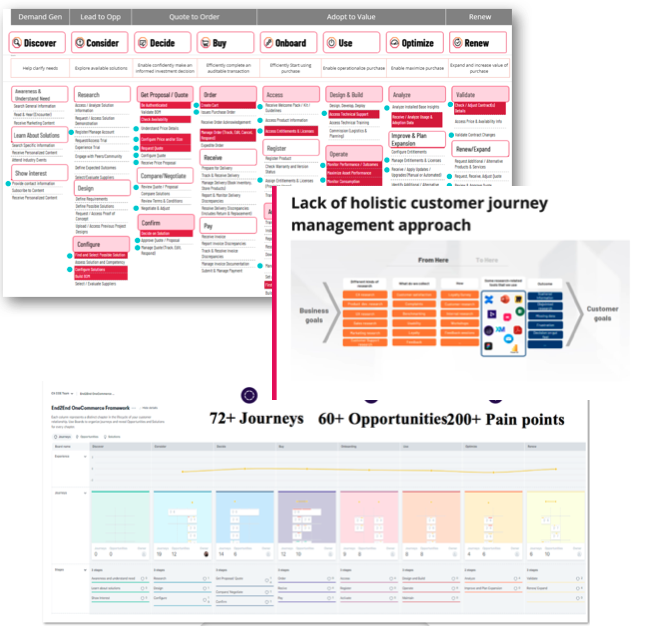
From this, we identified over 200+ pain points and created a heatmap of opportunities. We used these insights to:
- Highlight high-impact alignment gaps
- Develop business cases to support change
- Build a Customer Journey (CJ) Framework to serve as a shared structure between CX, product, and business teams
All efforts were captured and structured using the TheyDo journey management platform.
The Solution:
The final solution included:
- A visual heatmap of opportunities highlighting 60+ CX improvement areas across 72+ journeys
- A scalable Customer Journey Framework that helped synchronize cross-functional priorities
- Initiation of a strategic shift toward funding and resource allocation based on customer needs rather than internal assumptions
This framework became a foundation for long-term customer experience planning.
My Involvement:
Role: Senior Service Designer
I was responsible for:
- Analyzing available CX data and complaints
- Conducting qualitative user research to fill insight gaps
- Mapping the heatmap of opportunities
- Designing and implementing the Customer Journey Framework inside the TheyDo platform—including journey structure, taxonomy, and opportunity documentation
My work laid the foundation for more aligned and evidence-based CX initiatives across the organization.
 Service & Concept Design Researcher