
Design Thinking and Service Design put users at the center of their methodology and framework – they provide a holistic view of the solution and make it easy to identify gaps in the experience.
Service Design is a comprehensive and user-centric approach to designing and improving services.
It involves understanding the needs and expectations of users and stakeholders to create seamless, efficient, and delightful experiences.Service Design extends beyond individual touchpoints, taking into account the entire service ecosystem and its various interactions. It aims to align business objectives with user needs, resulting in a service that not only meets customers’ expectations but also enhances brand loyalty and overall business performance.
The activity of planning and organising a business’s resources (people, props, and processes) in order to (1) directly improve the employee’s experience, and (2) indirectly, the customer’s experience.Components of Service Design
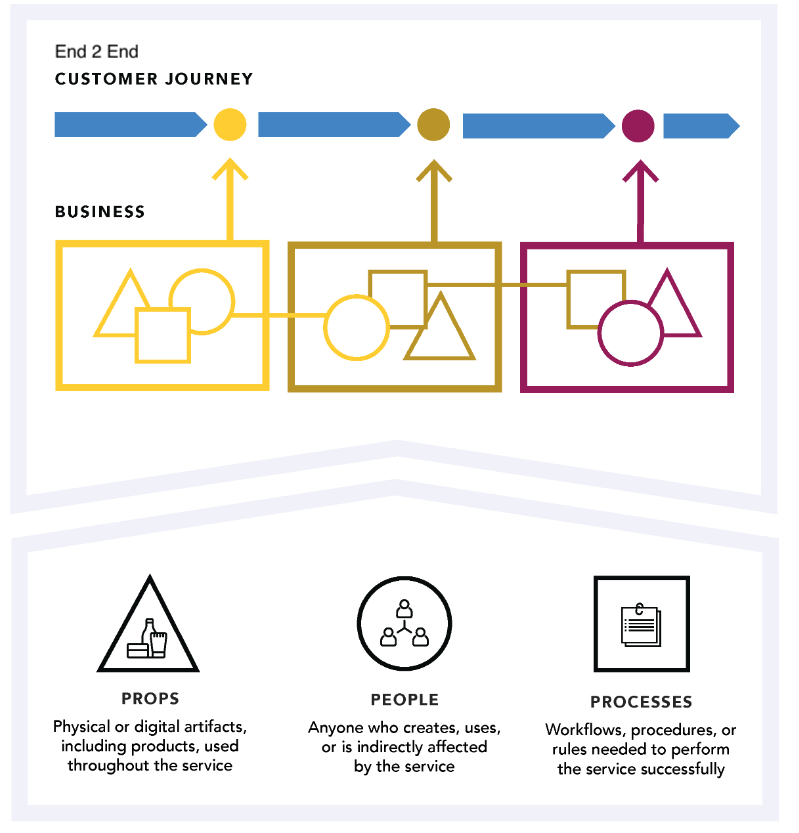

In user experience design multiple components must be designed: visuals, features and commands, copywriting, information architecture, and more. Not only must each component be designed correctly, but they also must be integrated to create a total user experience.
Service design follows the same basic idea. There are several components, each one should be designed correctly, and all of them should be integrated. The three main components of service design are people, props, and processes.
People
This component includes anyone who creates or uses the service, as well as individuals who may be indirectly affected by the service.
Examples include:
- Employees
- Customers
- Fellow customers encountered throughout the service
- Partners
Props
This component refers to the physical or digital artifacts (including products) that are needed to perform the service successfully.
Examples include:
- Physical space: storefront, teller window, conference room
- Digital environment through which the service is delivered
- Webpages
- Blogs
- Social Media
- Objects and collateral
- Digital files
- Physical products
Processes
These are any workflows, procedures, or rituals performed by either the employee or the user throughout a service.
Examples include:
- Withdrawing money from an ATM
- Getting an issue resolved over support
- Interviewing a new employee
- Sharing a file
Frontstage vs. Backstage
Service components are broken down into frontstage and backstage, depending on whether the customers see them or not. Think of a theater performance. The audience sees everything in front of the curtain: the actors, costumes, orchestra, and set. However, behind the curtain there is a whole ecosystem: the director, stage hands, lighting coordinators, and set designers.
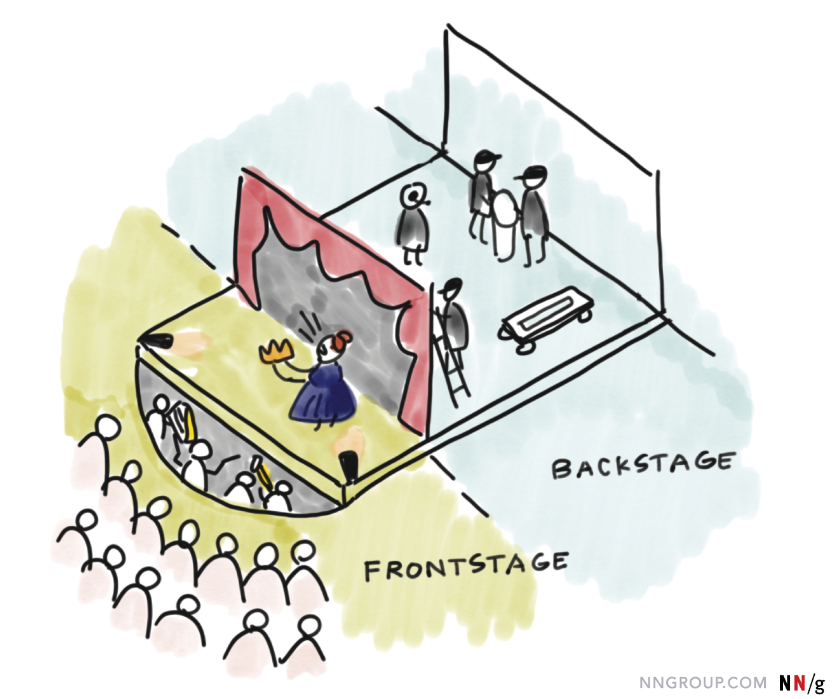
Though not ever seen by the audience, the backstage plays a critical part in shaping the audience’s experience. In a restaurant, what happens in the kitchen dictates what appears on your table.
Frontstage components include:
- Channels
- Products
- Touchpoints
- Interfaces
Backstage components includes:
- Policies
- Technology
- Infrastructures
- Systems
Difference between Service Design and UX
Service design revolves around creating end-to-end service experiences, encompassing all touchpoints and interactions with customers throughout their journey.
On the other hand, UX design focuses on crafting intuitive and user-friendly digital product experiences, aiming to deliver exceptional interactions and user satisfaction. Let’s dive into the specifics in more detail.
Key Concepts and Principles of Service Design
In service design, several key concepts and principles guide the process of creating exceptional experiences. These include:
- User Research: Conduct research to gain insights into user preferences, pain points, and behavior to inform design decisions.
- Customer Journey Mapping: Understanding the user’s journey through various touchpoints, interactions, and emotions to identify pain points and areas for improvement.
- Service Blueprinting: Visualizing the entire service process, including frontstage and backstage activities, to ensure a holistic view and streamline operations.
- Co-Creation: Involving users, stakeholders, and employees in the design process to gain valuable insights and create more relevant solutions.
- Ecosystem Thinking: Considering the interconnections between different parts of the service and their impact on the overall user experience.
Key Elements of UX Design
Key elements that define the field of UX design include:
- User Research: Conduct research to gain insights into user preferences, pain points, and behavior to inform design decisions.
- Information Architecture: Organizing content and information in a way that is easy for users to navigate and find what they need.
- Wireframing and Prototyping: Creating low-fidelity prototypes to test and iterate on design concepts before implementation.
- Interaction Design: Defining how users will interact with the product and ensuring the interactions are intuitive and efficient.
Differences and Overlaps
Scope and Focus
The scope of service design primarily extends to service-based experiences, including processes, interactions, and customer touchpoints. It aims to optimize service delivery and create memorable customer journeys. In contrast, UX design concentrates on the digital realm, focusing on creating user-friendly and delightful interactions within digital products such as websites, apps, and software.
Overlapping Methodologies
Despite their different scopes, service design and UX design share some overlapping methodologies.
Both disciplines heavily rely on a user-centered approach, involving users in the design process through methods like user interviews and testing. Additionally, both fields employ an iterative design process, continuously refining and improving solutions based on feedback and data analysis.
Challenges and Misconceptions
Challenges: One of the common challenges in service design is aligning multiple stakeholders’ interests and requirements while maintaining a user-centric approach. Additionally, implementing service design across large organizations can be complex, requiring coordination and buy-in from various departments.
Misconceptions: One misconception about UX design is that it solely involves creating aesthetically pleasing interfaces. In reality, UX design goes beyond visuals, emphasizing usability and functionality to provide meaningful experiences. Another misconception is that service design is only applicable to service-based industries, while it can also be adapted to enhance non-service products and processes.
 Service & Concept Design Researcher